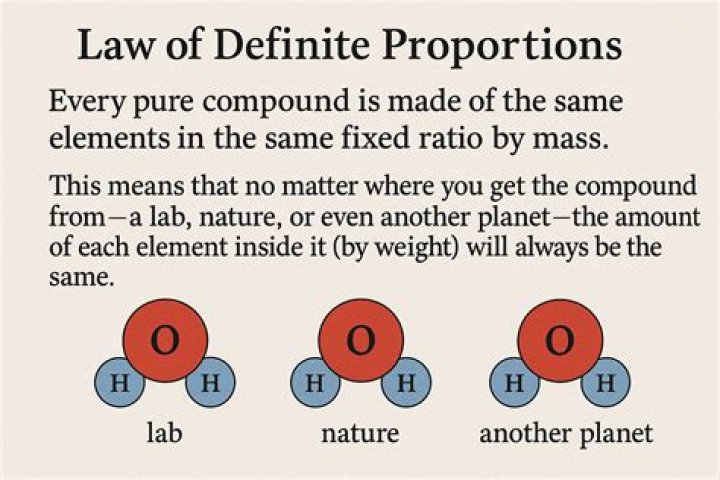
In chemistry, the law of definite proportion, sometimes called Proust’s law or the law of definite proportion, or law of constant composition states that a given chemical compound always contains its component elements in fixed ratio (by mass) and does not depend on its source and method of preparation.Click to see full answer. Also to know is, what is an example of the law of definite proportions?The Law of Definite Proportions states that a chemical compound will always have the same proportions or amount of each element by weight, no matter what the amount is, or source. For instance, a 50-gram sample of carbon monoxide will have 21.5 g of carbon and 28.5 g of oxygen.Likewise, how does the law of definite proportions apply to compounds? The law of definite proportions states that a compound always contains exactly the same proportion of elements by mass. This means that the composition of a compound does not depend on its source or its method of preparation. In this regard, why is the law of definite proportions important? The law of definite proportions dictates that a name is always associated with a specific ratio of elements found in a chemical compound. If the ratio of elements is different from that specific ratio then it is not the same compound and therefor has a different name.What is the difference between the law of definite proportions and the law of multiple proportions?The Law of Definite Proportions (or Proust’s Law) states that in a single chemical compound (such as H2O or CO) the ratio of it’s component elements is a fixed whole number ratio. The Law of multiple proportions applies when two or more elements/compounds have multiple ways of combining into different compounds.
What does the law of definite proportions mean?
By Emily Baldwin | Published January 12, 2026